The business of AI in 2026
Thinking beyond the hype to unlock AI’s business value
Introduction
Since we first published The Business of AI in 2025, the conversation about the business value of AI has quickly evolved. News that once stimulated mass public interest in a future of generative AI that could answer our questions and generate text on our behalf now seems remarkably older than it actually is. There’s a wealth of analysis now to confirm what we are observing in our conversations and partnerships with businesses who require custom software solutions to fulfil their objectives, often in regulated environments such as health, finance, education, and government. An increasing number of businesses who were initially focused on the experimentative phase of generative AI are looking to scale from pilots to wider production. Significant numbers are reported to have agentic AI solutions in production too.
Very recently, the UN flagged how quickly AI is accelerating. Despite recognising AI’s successes involving medical breakthroughs, better healthcare, and food security, the preliminary UN report into the capabilities, emerging opportunities and risks of AI highlighted that the technology is outpacing governments enlisted to establish effective global governance. At the global level, worldwide AI spending is forecast to total $3.73 trillion AUD in 2026, according to Gartner. In the space of less than two months earlier this year, we saw the launch of GPT-5.5, a preview version of DeepSeek V4, Gemini 3.1 Pro, Llama 4, and Qwen 3. Uber reportedly exhausted its 2026 AI budget in four months on Claude Code. As highlighted in our research, which surveys 1003 Australians about their use of AI at work, close to two thirds of Australian employees said they used AI for work.
For businesses, it’s timelier than ever to reframe the question from what AI does, to what to do with it. As Uber voiced after spending its entire 2026 budget in four months, clarifying the return on AI is complicated. Businesses are now thinking beyond AI adoption challenges, and identifying how AI is actually affecting business objectives.
Executive summary: Getting the best out of AI for business
With AI evolving as rapidly as it is, organisations adopting the technology need to be vigilant about its potential and pitfalls.
To help you consider how AI can play a positive role in your business, this whitepaper expands on the following key takeaways:

As businesses’ AI use cases accelerate, misestimations continue
- The enterprise market has expanded far beyond frontier US models to include highly capable, low-cost alternatives (such as DeepSeek and Qwen) and compact models that can run securely on local hardware.
- The conversation is shifting from purely generative outputs toward "agentic" systems designed to execute increasingly complex tasks with decreasing human supervision.
- Widespread market hype and speculative discussions about human-level AI continue to distort expectations.
- Companies who overestimate AI on account of hype risk overspending on compute and token consumption without delivering a measurable business return.
AI’s greatest challenge isn’t innovation–it’s bridging the gap between demo-level promise and real-world reliability
An AI demo is not a software system
- Modern AI tools make it deceptively easy to build a working prototype in hours. But a polished demo is a long way from a production-ready system.
- AI implementation relies on traditional software architecture built around the model. Quality software engineering is essential to manage context, enforce data permissions, handle errors, and maintain audit trails.
- Because large language models are inherently probabilistic (generating outputs based on likelihood rather than rigid rules), their behaviour is fundamentally unpredictable.
- To manage this unpredictability, engineering teams are advised to implement rigorous, automated evaluation frameworks to continuously monitor output quality. Without these system-level guardrails, a statistically minor error rate in testing can quickly compound into a major real-world operational liability.
A business problem should precede an AI solution
- A strong strategy begins by defining the operational problem and establishing strict metrics for success.
- Once these baseline requirements are set, leadership can effectively evaluate the technology stack and determine which model architecture fits the use case and budget.
- Scaling AI requires structured governance. This includes approved tooling pathways, robust data exposure policies to protect intellectual property, and practical financial controls over compute costs.
- Organisations should also ensure that staff use AI to augment their workflows, rather than outsourcing their critical thinking to the technology.
- Humans need to retain full accountability, and commensurate with risk and rates of error.
The organisations that benefit the most are those that govern AI with clear purpose, rigorous controls, and a disciplined approach to setting and achieving measurable business outcomes.
The AI hype cycle: overestimations and underestimations
Seeing AI’s business value for what it is means seeing through the machine-smoke and strobes of hype.
As one journal remarks, our collective and individual ability to understand generative AI (which is often messaged as “powerful”, “magical”, and “inevitable”) means filtering heavy narrative extremes and exaggerations about generative AI. This makes it challenging for people to make informed decisions about adopting the technology.
Last year, the MIT/NANDA State of AI in Business 2025 report highlighted one side of the AI adoption challenge, finding a vast majority of organisations who had adopted it were struggling to pinpoint its business impact.
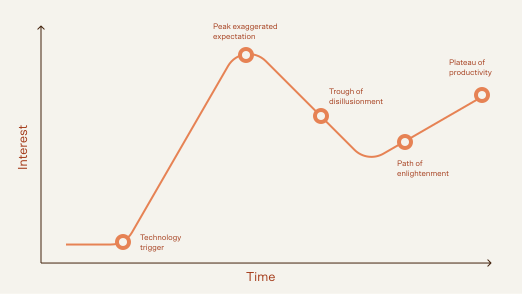
Gartner’s 2026 Hype Cycle for Agentic AI shows interest in agentic AI is accelerating, but adds organisations are still figuring out what agentic AI can realistically deliver.
We frequently talk to organisations who want AI systems, but don’t realise that classic computing can often deliver the desired result more affordably, simply, and reliably.

From proof of concept to production
Airteam recently produced a proof of concept in a pre-sales environment. The demonstration allowed one company to see how AI could operate within its existing digital product.
The demonstration might have taken close to 25 days to produce in Figma, but our team essentially vibe coded it in about 30 minutes. The demo had an LLM embedded, which appeared as a functioning part of the company’s website.
However, implementing the product to perform live in real conditions may have amounted to about $100,000 of additional work.
Recent media coverage about new book, The Reverse Centaur’s Guide to Life After AI, pointed out that some of AI’s best-known architects have dubbed the technology everything from human civilisation’s greatest threat to an exploitative force forecast to ultimately stable humans like animals. As the book’s author, Cory Doctorow, said: “AI people claim they’re about to create God, by teaching words to a word-guessing programme,” Doctorow says. “It’s grandiose.”
Hyperscalers have stratospheric voice reach to perpetually characterise AI as urgent, inevitable and commercially transformative. Narratives about epochal disruption and productivity revolutions abound. The challenge for business is to keep expectations realistic. That’s fundamental for measuring successful outcomes too.
At the same time, in spite of the effect hype has on business's overestimation of AI, businesses underestimate it too. Our research has found that 80% of workers aged 18 to 24 use AI tools at work, but only 41% of workers over 45 do. We have also identified that different cohorts, such as the 18-24 group, are reinvesting more of the time they have reclaimed to ultimately improve business outcomes for their organisations, which signals businesses are missing opportunities too.
It’s also important to keep in mind that AI can excel when it is applied to specific tasks. Many organisations capitalise when they apply AI to:
- Route information by sentiment or content.
- Extract structured data from unstructured material.
- Improve search and retrieval.
- Support code work.
- Create natural-language interfaces to work with databases, APIs, and internal systems.
Navigating the AI economy for better business results
In 2026, according to Bridgewater Associates analysis, major technology companies Alphabet, Amazon, Meta and Microsoft are expected to invest about AUD $1 trillion globally into the computing capacity behind AI (more recent figures indicate that figure will increase considerably again in 2027). Expanding AI capacity means investing in the physical systems required to run it, such as data centres, specialist chips, electricity supply and cooling. High-cost hardware such as Nvidia’s GPUs are a big cost for data-centre fit-outs, and these costs flow from big tech organisations to businesses investing in AI models and AI-powered digital products and tools. This highlights why unchecked AI use misaligned with clear business outcomes, including high token consumption, can become a cost issue.

Price check
AI model choice can significantly change operating cost.
Reuters reported in May 2026 that DeepSeek’s V4-Pro API pricing ranged from about US$0.0035 to US$0.83 per million tokens, while Claude Opus 4.6/4.7 pricing has been reported at US$5 per million input tokens and US$25 per million output tokens.
A frontier model may be right for some tasks, but other work may be better served by a smaller model, local model, retrieval system, or conventional software approach. The question to ask is which delivers the required result more reliably and cost-effectively.
As demand for more powerful AI models grows, so des the need for enormous computing power and specialised hardware, shaping the landscape of AI innovation.
It’s timely now to consider that, alongside frontier US companies such as OpenAI, Anthropic, Google and Meta, businesses can now consider cheaper non-US AI models, including China’s DeepSeek and Qwen. Remember too, the constellation of AI models includes models such as Gemma, Phi, Llama and Mistral, which are available as ultra-compact and highly-optimised versions.
With more variety and more affordable options available, consider their specific task requirements, along with models’ reliability, security, performance, and operating costs, rather than how popular or new the model is.
Practical applications of AI in business today
The National AI Centre’s AI Adoption Tracker indicates that AI adoption amongst Australia’s SMEs is highest in the services industry (30.4%). Deloitte’s 2026 AI Dossier highlights compelling AI use cases across six major sectors, including consumer, energy and resources, financial services, government and public services, life sciences and health care, and technology, media, and telecommunications.
Across those sectors, the research pinpoints 130 AI use cases for business, including dynamic pricing and inventory optimisation, risk management and regulatory compliance, technical sales support, and clinical decision support. It finds that organisations are analysing large amounts of information, coordinating decisions, reducing manual handling, detecting risk and responding faster than they would with traditional processes.
Our advice for businesses is to note that the strongest AI opportunities are the ones where the technology is clearly matched to a business problem, evaluated against real outcomes, and supported like any other critical software system. Organisations should treat an AI model like a function inside a larger system (and less like all-purpose intelligence). Software gives an AI model its inputs; the model returns outputs; the surrounding system decides what to do with those outputs.
Testing is essential to this process. If an AI feature reads a document, sorts a request, searches internal material, summarises a record, or helps staff query a business system, the organisation needs a way to check whether it worked. When a new failure or edge case appears, it should be added to the evaluation framework so the system can be improved in the next release.
Here are some further AI uses that organisations can consider to help improve business outcomes.
Reading documents and extracting information
One of the clearest practical uses of AI is turning unstructured information into structured data. This can include extracting information from invoices, receipts, forms, emails, reports, images or handwritten documents. This information can be passed into an existing workflow. These applications are useful because they reduce manual handling of repetitive information-heavy tasks.
Sorting requests and moving work to the right place
AI can also help classify information and route to the right destination. If a customer service team receives a customer message, support request, internal document, or service ticket, AI can assess the topic, urgency or sentiment before directing the message to the right team, system, or next stage in the pipeline. Similar classification and pattern-detection is also used in areas such as fraud detection, cybersecurity triage, quality control and compliance monitoring. AI can help flag anomalies or higher-risk cases for human review.
Finding and using internal knowledge
Advanced retrieval systems use embeddings and semantic search to surface relevant documents, records, or knowledge-base material, even when users do not know the exact keywords to enter. This approach makes internal search significantly more useful than traditional keyword matching. It is especially helpful for organisations with large amounts of text or historical material spread across disparate systems.
Asking questions of business systems
Implementing natural-language interfaces allows users to interact directly with databases, APIs, dashboards, and internal systems. Rather than manually building custom reports or writing complex queries, team members can use natural language to surface relevant tables, charts, or structured data from approved data sources. While this capability does not replace the foundational need for robust data engineering, it significantly improves data accessibility and maximises the value of existing information systems.
Supporting software development and technical delivery
AI is increasingly used in software development to assist with code generation, debugging, testing, documentation and prototyping. AI coding tools can help developers move faster, but they do not remove the need for software architecture, security review, quality assurance, or experienced engineering judgement. Reliable software still depends on the surrounding engineering discipline, but coding assistants and tool-using systems can support delivery teams.
Customer-facing tools and chatbots
Integrating LLMs into customer-facing applications such as chatbots, service assistants and recommendation systems is a helpful way for businesses to handle well-defined requests backed by clear escalation avenues to human support. These applications can create poor customer experiences if they are mainly used to reduce call-centre volume (rather than authentically solve customer problems) however. Instead of asking if a chatbot can be added to your business, ask if it genuinely helps your customers or digital product users complete their task.
Where AI falls short
Businesses investing in AI should be aware that the technology can fall short when it is required to produce work that must be accurate, up to date, and safe to act on. The risk becomes greater when AI is built into business technologies such as customer service tools, document-processing systems, internal knowledge bases, reporting dashboards or recommendation engines. The risk should be especially closely monitored in sectors such as healthcare, finance, government and professional services, where privacy and security compliance is strictly regulated.
AI won’t perform the same task consistently
Many organisations need to perform particular tasks consistently to meet the standards customers or the public expects. If multiple customers ask about the same refund policy, the answer needs to be consistent. LLM AI generates varying responses to the same question. When they receive small differences in wording, context, or available information, the result can change too. Organisations need to manage the risks of AI generating misinformation.
AI struggles with messy real-world inputs
AI demos work best when the conditions are controlled to be ideal. An AI customer-service tool might answer a clearly written question about a refund policy well. An invoice-processing tool might extract details from a complete invoice. A document assistant might accurately summarise a pristine policy document.
Real-life business is different however. A customer may write a support request that is unclear, poorly worded, or missing key details. An invoice may have no purchase order number, a wrong supplier name, handwritten notes, or clunky formatting. An employee using an internal AI assistant may ask a question using company shorthand, old policy wording, or incomplete background information. The answer may also depend on information stored somewhere else, such as a CRM, finance system, knowledge base or shared drive. AI may not be able to access this or interpret correctly.
The AI model needs surrounding software
Businesses need to integrate AI models into broader software systems for context, controls, and coordination. Although the LLM behind an assistant in a financial services business might generate a summary about what has happened with different customers’ accounts, it doesn’t automatically understand the business rules that govern how that information should be used.
The software around the model has to apply those rules. It needs to decide which information the model receives, the data the user is allowed to access, and what should happen next. It also needs to connect with existing systems such as CRMs, industry platforms, document stores and reporting tools, so the AI is working with the right information.
The hard work is not only getting an AI model to answer. It is building the system around it so the answer can be used safely and reliably.
AI models generate large volumes of content without quality assurance
Generative AI can quickly produce large amounts of text, code, images or video that may be useful for first drafts, rough concepts, internal summaries or low-risk support tasks, but sub-par for assets that are characteristically precise, original, on-brand, technically accurate or professionally finished.
If an organisation develops a false sense of progress through its AI-enabled production activities, its teams may suddenly have more draft copy, code suggestions, image options or content variations that need significant human effort to check, edit, rebuild, or replace. In creative and customer-facing work, low-quality AI material can also weaken trust, if the target audience sees the production as generic, inaccurate, or artificial.
New chapters in AI
After generative AI mainstreamed in 2025, agentic AI has made a major impression this year. Numbers from Deloitte state that 69% of Australian organisations are using autonomous AI agents, evolving the role of AI from generating text or insights to actively executing tasks across workflows.
Alongside agentic AI, here are some other developments in model optimisation and data architecture that can make deployment easier.
Embedded AI
Embedded AI is becoming more practical as compact hardware makes it possible to run AI closer to where data is created. With embedded AI, AI runs on or near a device, such as a camera, sensor, drone, vehicle or field unit, rather than sending every image, video stream, or sensor reading back to a central cloud system.
With embedded AI on a large farm, for example, trail cameras could identify predators that might attack livestock, and send only relevant alerts or metadata, rather than transmitting every image over expensive satellite connections. Similar logic could apply to drones monitoring illegal fishing, smart traffic infrastructure responding to emergency vehicles, or industrial sensors flagging only the readings that need attention.
NVIDIA Jetson boards are already used for AI workloads in edge and mobile environments, and Raspberry Pi’s AI HAT+ 2 for Raspberry Pi 5 adds a Hailo-10H accelerator with 40 TOPS of AI performance and 8GB of dedicated memory for compact local models.
For businesses, embedded AI can reduce network and cloud costs, improve response times, and make AI more practical in remote, mobile, or infrastructure-heavy environments.
Smaller and specialised local models
Smaller models are becoming a more serious option for business use. Google’s Gemma family and Microsoft’s Phi models, which have been positioned as lighter-weight models that can run more efficiently and, in some cases, locally, on devices.
The increasing range of models gives businesses more choices to consider when deciding which model is task-appropriate, affordable, and secure.
Vector search redefines information retrieval by enabling semantic understanding, driving precision and personalisation across industries like healthcare, legal and education.
Vector search expansion
Organisations are increasingly leveraging vector search to enable true semantic understanding across enterprise data. By indexing information based on context and meaning, rather than literal text strings, teams can interact more capably with complex high-volume content libraries.
This is particularly valuable in industries like healthcare, legal, and education, where vast content libraries require precise indexing and retrieval.
Healthcare: Accelerates clinical research and diagnostic support by surface-indexing medical records, trial data, and academic studies based on clinical context, even when terminology varies across systems.
Legal: Enhances case law research and contract analysis by identifying documents sharing similar legal principles, compliance risks, or clause intent, regardless of the specific phrasing used.
Education and R&D: Simplifies academic discovery by mapping historical repositories to overarching research themes, allowing institutions to surface highly relevant resources and tailored material based on conceptual alignment.
Investing in vector search infrastructure is an effective practice for breaking down information silos. It can reduce speed-to-insight for specialised staff and improve access to unstructured data assets.
Fine-tuning LLMs with domain-specific data unlocks precision, scalability, and competitive edge in industries where accuracy and expertise are vital.
Fine-tuning LLMs for specific industries
Fine-tuning LLMs on domain-specific data enables companies to achieve competitive advantages, particularly in industries where specialised knowledge and high accuracy are crucial. It can be especially valuable in fields like healthcare, finance, and legal services, where standard LLMs may struggle with nuanced terminology or complex regulatory language. Fine-tuning ensures the model understands the unique context and requirements of the sector or domain, resulting in more precise and useful outputs.
This approach also allows businesses to create tailored applications, such as specialised customer service solutions, that align closely with their products or services. By integrating proprietary knowledge directly into the AI, companies can safeguard their intellectual property and maintain a competitive edge. Furthermore, in high-stakes environments like healthcare or finance, fine-tuned models can help meet strict accuracy and compliance standards, supporting better decision-making and operational reliability.
Agentic AI
Agentic AI, which refers to an AI system that completes particular tasks with limited human supervision, can independently solve real-time problems for organisations. Agentic AI is a fast-developing area where AI systems do more than produce an answer. They may call APIs, search databases, edit code, retrieve documents, update records or trigger steps in a workflow. Businesses can use them to assist with risk audits in banking and finance, write basic news articles in the media, retrieve customer data in retail, or reduce the administrative burden of billing and scheduling in healthcare.
Practical guidance for adopting AI
Boston Consulting Group’s (BCG) Build for the Future x AI 2025 Global Study, attributes about 70% of AI’s value to rethinking the people component, which means focusing on better strategic alignment from the top of the company, managing holistic employee behaviour change, upskilling staff, and managing human-AI workflows.
When AI is adopted successfully, organisations can expect to see improved decision-making speed companywide, high uptake among internal users, clear investment dividends, better operational processes, and automated system interoperability.
To make your integration successful, planning is paramount. Here are some priorities to integrate better AI-enabled business outcomes.
Identify real business problems
- Before choosing AI models or tools, be clear your business problem is important enough to consider solving with AI investment.
- Common pain points for businesses include slow customer response times, manual document handling, repetitive admin work, high product returns, and difficulty searching information.
- Some of these problems may be better solved through process change, better data management, system integration, or conventional software. Ask what needs to be improved, and then ask if AI has a part to play.
Map AI to specific use cases
- A worthwhile AI project should have clear purpose, clear inputs, clear outputs, and ways to check if it’s working.
- Choose use cases by looking at tasks staff already perform repeatedly, such as extracting fields from invoices, routing support requests by topic or urgency, or summarising customer records.
- These tasks are easier to test because the organisation can compare time, accuracy, review burden, and error rates before and after AI is introduced.
Test in real-world conditions
- A tool that works on a clean demo may behave differently when customers ask unclear questions, documents are incomplete, policies are outdated, or information is spread across multiple systems.
- Testing should therefore include realistic examples, imperfect data, and failure cases.
- Organisations need to understand where the AI performs well, where it performs poorly, and what level of error is acceptable for the specific use case.
Choose the right model and technical approach
- Organisations should choose the model and technical approach based on the task, cost, data sensitivity, reliability requirements and operating environment.
- A frontier model may be appropriate for complex language or reasoning tasks. A smaller-scale model may be better for narrower tasks, private data, lower operating costs or more controlled deployments.
- In some cases, classic computing might be better for search, rules-based software, system integration or process improvement.
Build governance into the process
- Responsible AI adoption needs clear rules around how AI tools are selected, used, tested, and monitored.
- Organisations should define what data can be entered into AI systems and decision-makers should be clear about which outputs require human review, who is accountable for AI-assisted work, how errors are reported, and how records are kept.
- This is especially important in sectors such as healthcare, finance, government and professional services, where organisations must meet strict requirements around privacy, security and confidentiality.
- Governance shouldn’t be treated as a separate policy exercise after the fact. It should shape how the AI feature is designed, tested, deployed and maintained at the outset.
Redesign work activities around AI where useful
- Deloitte argues that more advanced organisations are beginning to redesign workflows, roles and career paths around AI, rather than simply adding AI tools to existing processes. AI may handle routine execution tasks while people focus on judgement, exception handling, quality control and strategic oversight.
- AI adoption should eventually move beyond individual productivity gains. If a use case proves valuable, organisations may need to decide how the process should change, who remains accountable, what new review roles are needed, and how human and AI work should fit together.
- The goal should be to design work so AI and people combine symbiotically.
Start small, learn, then scale
- The safest path to successful organisation-wide AI usually starts with a focused use case.
- Test pilots with real users and real data, and only scale up once the organisation understands the benefits, limits and risks.
- Early projects should be specific enough to evaluate and low-risk enough to improve without serious consequences if the first version falls short.
- Scaling should come after the organisation has evidence that the AI feature improves the work, can be governed properly, and can be maintained over time.
- Remember that AI adoption is a product, process, workforce, data, security and accountability decision, as well as technological.
Invest in R&D to uncover niche AI applications, turning untapped potential into tailored solutions that drive efficiency, insights, and competitive advantage.
AI’s real impact today
AI’s impact should be measured by what it helps the organisation improve. That may include faster customer response times, shorter handling times, fewer manual steps, better access to approved information, or fewer errors in routine document handling.
Most enterprises have launched AI projects, but results remain mixed. Investment in the right technical architecture to scale AI effectively and securely is paramount.
The strongest opportunities are unlikely to come from treating AI as a general answer to every business problem. The key question to think about is whether AI helps your organisation solve a real problem in a future-focused way that can be measured, trusted and sustained.