Australia's fuel crisis response is already written. It starts with working from home.
Airteam research of 1,000+ Australians shows strong support for working from home and demand-side fuel measures. See the full data and implications.

A fuel crisis is, at its core, a logistics problem.
And new research suggests Australians have already identified the most direct solution: use less fuel by not travelling to work in the first place.
We asked the question because, as software developers over COVID, we grew - and to reasonable extents - remain a WFH team. We’ve made it work and it’s enabled us to bring on members of the team right across Australia.
We wanted to test the waters to see if our team shared the aspirations of others as we potentially bunker down. And it turns out they do.
In a nationally representative survey of more than 1,000 Australians, conducted by Airteam, 97% of respondents were willing to accept at least one meaningful demand-side measure to address a prolonged fuel shortage.
Across all tested options, average support did not fall below 7.4 out of 10. (The public is not waiting to be convinced.)
When asked to name their preferred response, the answer was clear: working from home.
Que the fierce debate and pushback by business groups. (And we acknowledge there are two sides of the debate, and we are not picking one: we’re just presenting the data.)
Working from home is the nation's first choice
57% of Australians rated WFH their top demand-side solution, with an average support score of 8.2 out of 10. That puts it ahead of public transport incentives (50.4%), fuel excise cuts, and fuel reserve releases (43.8%).
The preference is not generational either.
While Gen Z and Millennials drive it most strongly, 88.6% of all respondents gave WFH a positive rating of six or above.
We’re talking cross-generational consensus.
The reasoning is straightforward we believe.
"COVID forced businesses to build remote work capability almost overnight, and now a fuel crisis is calling on that investment for the second time," said Rich Atkinson, Executive Director of Airteam. "The businesses that adapted in 2020 are in a strong position. The ones that quietly dismantled their remote infrastructure the moment offices reopened are about to find out what that decision costs them."
Beyond WFH: the supporting measures
For Australians who cannot work from home, public transport is the next most powerful lever, but uptake is acutely price-sensitive.
- 61% would increase use with some form of financial incentive.
- Making it completely free pushes that figure to 82%, a 21-percentage-point jump that signals just how much cost is the barrier, not willingness.
- 70% say a financial incentive is a prerequisite for them to make the switch, and 52% say increased service frequency is equally non-negotiable.
- NSW leads readiness to shift, with 45% saying they would use public transport significantly more, followed by Victoria at 41%.
- On air travel, 77% of Australians support reducing flights during a fuel shortage, with non-essential leisure and short-haul routes as the clear targets.
- But there is a firm line: increasing ticket prices ranked last among every proposed measure. Australians will accept reduced access. They will not accept a system where access is determined by income.
The reserve question and the generational divide
Beneath all of this sits a more fundamental anxiety.
- 50% of Australians do not believe the nation holds sufficient fuel reserves, and just 27.7% are confident that it does.
- Nearly three in four Australians are either worried or simply do not know.
That concern breaks sharply by generation.
- 67.9% of Boomers believe reserves are insufficient, compared to 45.2% of Millennials and 45.8% of Gen Z.
- Boomers want the immediate crisis stabilised first: 54.7% rated fuel reserve releases as their top measure, averaging 8.5 out of 10.
- Gen Z, by contrast, rated reserve releases at just 7.2 out of 10 and at 26.9% as a top option.
- Their instinct is to change behaviour and protect environmental standards, even under pressure.
- The divide is not about willingness to act; it is about the time horizon.
- Our reading of the data is that older Australians want the crisis contained. Younger Australians want the response to also be the beginning of something better.
The infrastructure is ready. The question is whether organisations are.
What this research ultimately reveals is that public readiness is not the constraint.
Nearly every Australian is willing to do something. The more consequential question is whether the organisations, networks, and systems around them are positioned to support that willingness when it matters.
For remote-capable businesses, the answer should already exist.
The organisations that maintained their WFH infrastructure are the ones that will move fastest. Those who did not are facing a second reckoning, and this time the pressure is coming from outside their walls.
We all have mixed memories of the lockdown, and not to speak lightly of the current situation, our favourite remains when one of Australia’s leading experts accidentally tweeted: “Dan Murphy opening hours”, mistaking Twitter for Google.

About the data
The data used in this release is from a survey commissioned by Primara Research for Airteam, with a nationally representative sample of 1,001 adult Australians, that were asked about their opinions on how Australia should deal with the fuel supply crisis.
Update
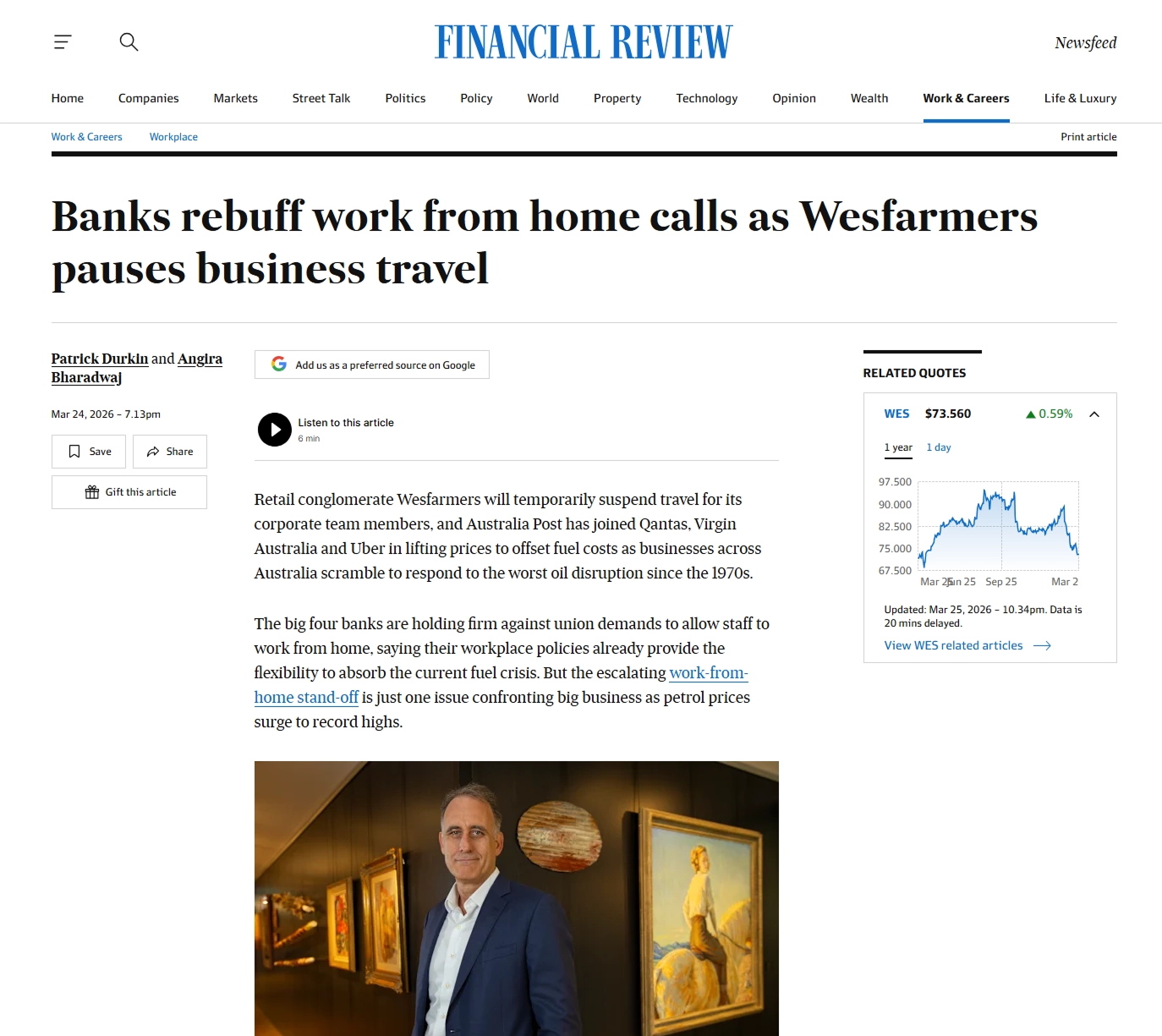
Things are starting to feel serious, and we were proud when the Australian Financial Review asked if they could cite some of our research when it came to the prickly topic of WFH and the fuel crisis.
We’re just the messenger here.