Why are NSW's vulnerable road users being left behind?
NSW has delivered meaningful improvements for car occupants over 25 years. The same cannot be said for pedestrians, cyclists, and motorcyclists.
The numbers that should trouble us
In NSW, cyclists account for about 1.2% of trips taken and 15.7% of serious injuries.
This 13-fold over-representation is not an anomaly. It sits within a broader pattern: while car occupants have benefited from decades of safety gains (airbags, stability control, automatic emergency braking), those outside vehicles face a different reality.
The data points to three recurring forces: VRU (Vulnerable Road User) harm is undercounted in the primary public dataset (police crashes), VRUs are exposed to suburban-speed environments where severity rises sharply, and enforcement signals do not consistently align with harm reduction.
Pedestrian deaths in NSW rose 21% between 2020 and 2024. Motorcyclist deaths rose 49% over the same period. Total road fatalities are tracking 15% above the three-year average.
These figures demand examination. What follows is an attempt to understand why, using the data NSW collects but rarely presents together.
Note: “Vulnerable road users” (VRUs) here refers to pedestrians, cyclists, and motorcyclists. Some national benchmarking datasets use a narrower VRU definition (pedestrians + cyclists only); where used, that distinction is noted.
Figure 1: Cyclist over-representation in serious injuries
Vulnerable road users (for our purposes; pedestrians, cyclists, and motorcyclists) comprise a small fraction of trips but a disproportionate share of trauma.
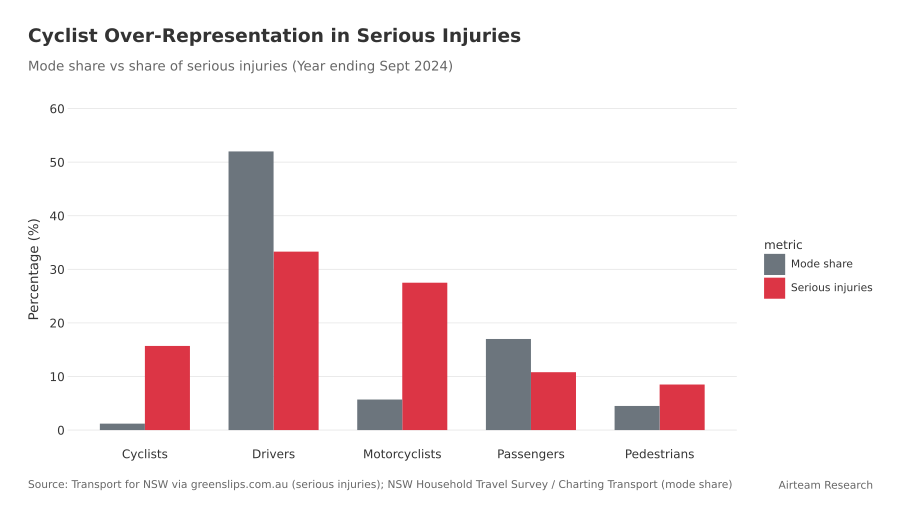
Figure description: A paired bar chart comparing mode share (percentage of trips) against share of serious injuries for each road user category. The gap between the two bars represents over- or under-representation in crash outcomes.
| Comparison criteria | Mode Share | % of Serious Injuries | Representation Factor |
|---|---|---|---|
| Drivers | ~52% | 33.3% | 0.6x (under) |
| Passengers | ~17% | 10.8% | 0.6x (under) |
| Motorcyclists | 5.7% | 27.5% | 4.8x (over) |
| Cyclists | 1.2% | 15.7% | 13.1x (over) |
| Pedestrians | 4.5% | 8.5% | 1.9x (over) |
Source: Transport for NSW serious injury data (Year Ending September 2024); NSW Household Travel Survey (mode share)
The contrast is stark. Motor vehicle occupants are under-represented in serious injuries relative to their travel share. Every category of vulnerable road user is over-represented, cyclists dramatically so.
Figure 2: The data we don't collect
Policy is shaped by data. In road safety, the primary dataset is police-reported crashes. But police data captures only a fraction of serious injuries, and that fraction varies significantly by road user type.
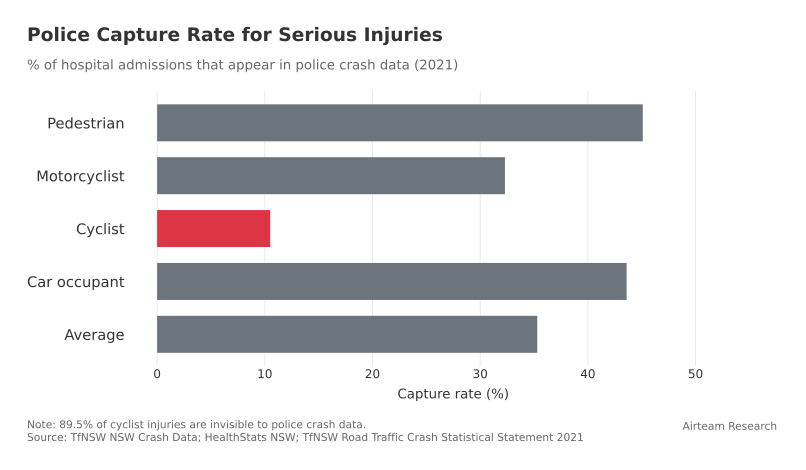
Figure description: A horizontal bar chart showing capture rates (the percentage of hospital admissions for serious injury that appear in police crash records) by road user type.
| Comparison criteria | Hospital Admissions | Police Records | Data Capture Rate |
|---|---|---|---|
| Car occupants | 4,100 | 1,787 | 43.6% |
| Pedestrians | 802 | 362 | 45.1% |
| Motorcyclists | 2,453 | 793 | 32.3% |
| Cyclists | 2,330 | 245 | 10.5% |
| All road users | 10,227 | 3,607 | 35.3% |
Source: TfNSW Statistical Statement 2021; NSW Health hospitalisation data
Nearly nine in ten cyclists sustaining serious injuries (89.5%) do not appear in police statistics.
Some of this gap will reflect unreported single-vehicle incidents and differences in reporting and attendance. But the result is the same: infrastructure planning, enforcement priorities, and funding decisions are often made using a dataset that captures cyclist serious injuries at roughly one-tenth the rate implied by hospital admissions.
In effect, a large share of cyclist trauma is missing from the primary public dataset used to describe road harm.
That matters because the next question is not just how much harm occurs, but where severity is concentrated. Even with the limitations of police crash records, the crash dataset still shows a clear relationship between speed environment and fatal outcomes—and it helps identify the speed zones where VRU safety policy has the most leverage.
Figure 3: Fatality rate by speed zone
NSW crash data from 2016-2024 shows how fatality risk increases with posted speed zones, and how that pattern differs by road user type.
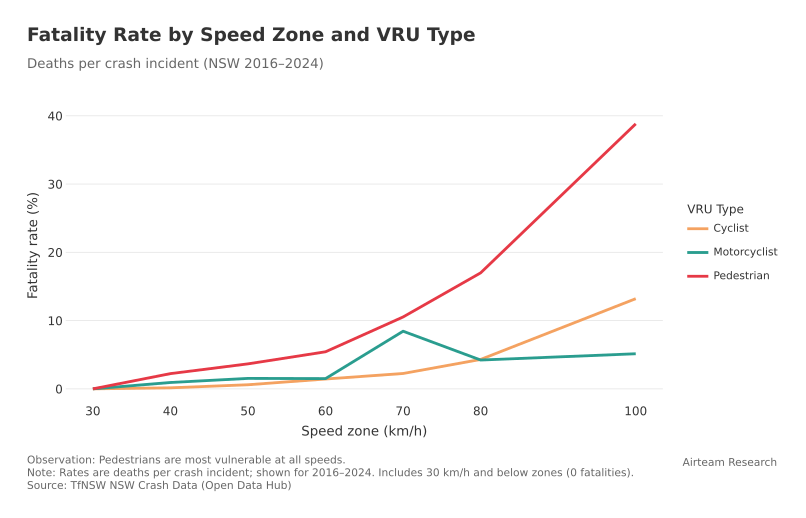
Figure description: A line chart showing fatality rate (deaths per crash incident) by speed zone for pedestrians, cyclists, and motorcyclists. The x-axis shows speed zones (30 km/h and below, 40, 50, 60, 70, 80, 100); the y-axis shows fatality rate (%).
| Comparison criteria | VRU Crashes | Deaths | Fatality Rate |
|---|---|---|---|
| 10 km/h | 58 | 0 | 0.00% |
| 20 km/h | 36 | 0 | 0.00% |
| 30 km/h | 172 | 0 | 0.00% |
| 40 km/h | 3,093 | 41 | 1.33% |
| 50 km/h | 14,926 | 303 | 2.03% |
| 60 km/h | 10,199 | 264 | 2.59% |
| 70 km/h | 1,499 | 127 | 8.47% |
| 80 km/h | 2,717 | 154 | 5.67% |
| 100 km/h | 2,402 | 185 | 7.70% |
| 110 km/h | 400 | 41 | 10.25% |
Source: TfNSW NSW Crash Data (Open Data Hub), 2016–2024 (fatality rate = deaths per crash incident)
Across VRU crashes in zones with speed limits of 30 km/h or below, there were zero fatalities. Above that threshold, pedestrian fatality rates rise sharply with speed (2.23% at 40 km/h, 3.66% at 50 km/h, 5.43% at 60 km/h).
The default urban speed limit in NSW is 50 km/h. Published research on impact speed (not posted zone) suggests an ~80% probability of pedestrian death when struck at 50 km/h, and ~10% at 30 km/h.
Forty-one percent of all VRU crashes occur in 50 km/h zones. Combined with 60 km/h zones, the figure reaches 69.2% (2016–2024). Including 40 km/h zones, 77.7% of VRU crashes occur in 40–60 km/h environments.
Figure 4: VRU crash concentration in 50 km/h zones
Different road users have different exposure patterns. Pedestrians and cyclists are concentrated in lower-speed urban environments.
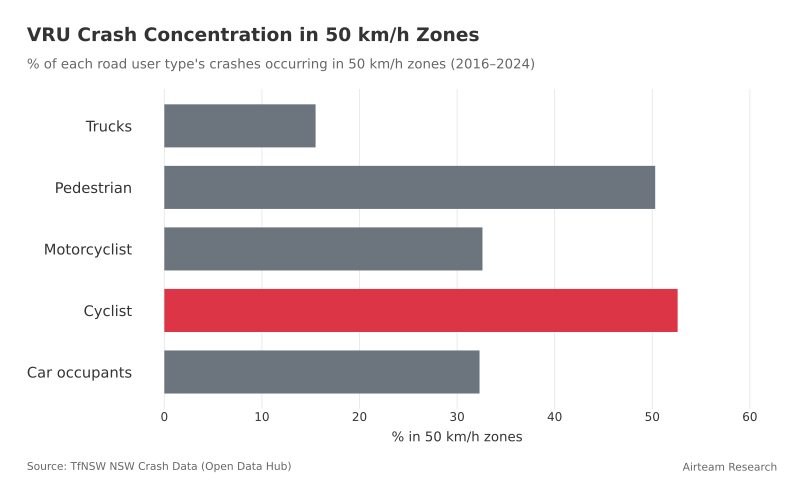
Figure description: A horizontal bar chart showing the percentage of each road user type's crashes that occur in 50 km/h zones.
| Comparison criteria | Total Crashes (2016–2024) | Crashes in 50 km/h Zones | % in 50 km/h |
|---|---|---|---|
| Cyclists | 6,602 | 3,473 | 52.6% |
| Pedestrians | 9,998 | 5,027 | 50.3% |
| Motorcyclists | 19,727 | 6,426 | 32.6% |
| Car occupants | 125,502 | 40,566 | 32.3% |
| Trucks | 14,449 | 2,234 | 15.5% |
Source: TfNSW NSW Crash Data 2016-2024
More than half of cyclist and pedestrian crashes occur in 50 km/h zones or approximately 1.6 times the concentration of car occupant crashes. The default urban speed limit disproportionately affects those most vulnerable to it.
Figure 5: The decade of stagnation
Road safety outcomes for car occupants have improved substantially over 25 years. For cyclists, the picture differs.
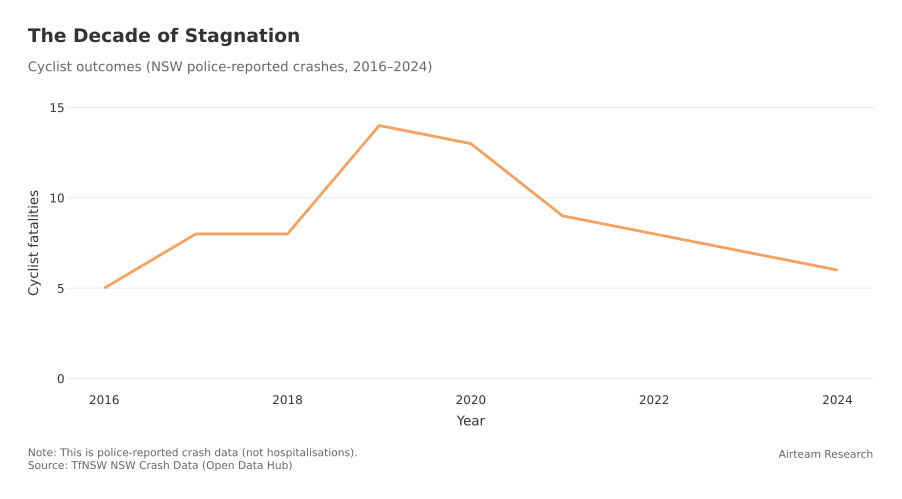
Figure description: A line chart showing cyclist fatalities by year (NSW police-reported crashes, 2016–2024).
Note: This figure uses police-reported crash fatalities. Serious injury trends are less directly comparable over time because hospital-admission series are not consistently integrated into public crash reporting.
| Comparison criteria | Cyclist Fatality Trend | Cyclist Hospitalisation Trend |
|---|---|---|
| 2010–2020 | Flat (no reduction) | +1.5% per year (1999–2016) |
| 2010–2016 | Flat | +4.4% per year (accelerating) |
Hospitalisation increase by age group (1999-2016)
| Comparison criteria | Increase |
|---|---|
| 45–64 years | +600% |
| 65+ years | +500% |
Source: Australian Institute of Health and Welfare; BITRE
Car occupant deaths fell 36.9% between 1995 and 2023. Cyclist fatalities showed no meaningful reduction over the decade to 2020. Meanwhile, cyclist hospitalisations increased—and accelerated. The growth in middle-aged and older cyclist hospitalisations reflects changing demographics of cycling, but infrastructure and policy have not adapted accordingly.
A flat trend can be interpreted in two ways: either NSW has reached an irreducible baseline risk for cycling, or the systems that drove improvements for car occupants have not delivered comparable gains for those outside vehicles. One way to test that is to step outside NSW and compare outcomes against the national benchmark.
Figure 6: NSW in national context
Comparing NSW vulnerable road user fatality rates against the national benchmark provides geographic context.
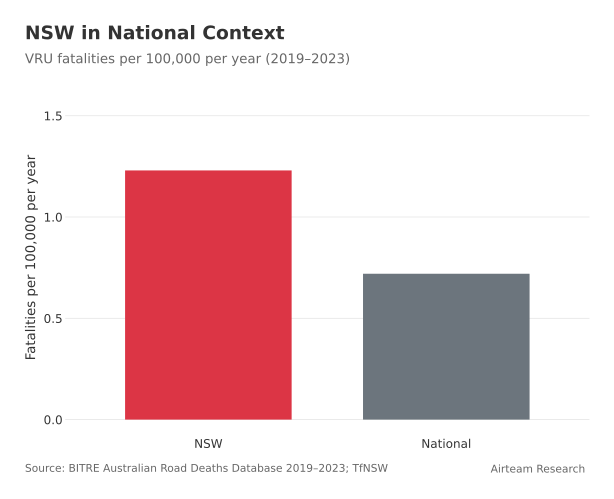
Figure description: A simple comparison showing NSW's VRU fatality rate against the national average, expressed as a ratio.
| Comparison criteria | National Rate | NSW Rate | NSW vs National |
|---|---|---|---|
| VRU fatalities per 100,000/year | 0.72 | 1.23 | 1.7× higher |
| Pedestrian fatalities per 100,000/year | 0.57 | — | — |
| Cyclist fatalities per 100,000/year | 0.15 | — | — |
Source: BITRE Australian Road Deaths Database 2019-2023; TfNSW
NSW's vulnerable road user fatality rate sits 70% above the national average. This gap warrants investigation: is it exposure (more VRU travel), environment (road design), speed limits, enforcement, or some combination?
Figure 7: Risk per distance travelled
The risk calculus changes depending on mode of transport. Per kilometre travelled, vulnerable road users face substantially higher fatality risk.
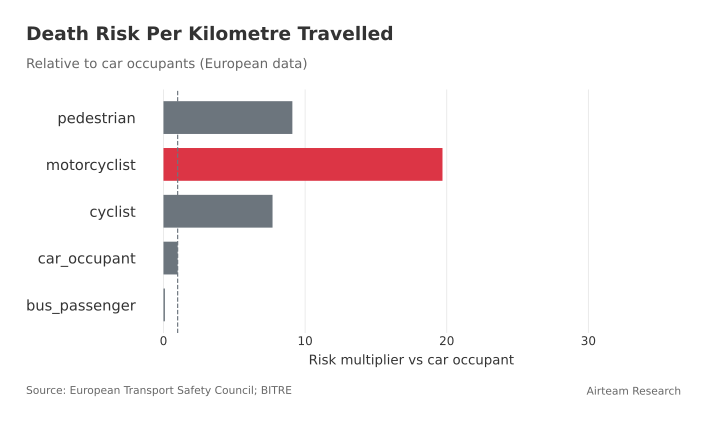
Figure description: A horizontal bar chart showing relative death risk per kilometre travelled, with car occupants as the baseline (1x).
| Comparison criteria | Deaths per 100M person-km | Risk vs Car Occupant |
|---|---|---|
| Car occupant | 0.7 | 1× (baseline) |
| Bus passenger | 0.07 | 0.1× |
| Cyclist | 5.4 | 8× |
| Pedestrian | 6.4 | 9× |
| Motorcyclist | 13.8 | 20× |
Source: European Transport Safety Council; BITRE (Australian motorcyclist data indicates 30x risk)
A pedestrian travelling one kilometre faces nine times the death risk of a car occupant travelling the same distance. For cyclists, the multiple is eight. For motorcyclists, Australian data suggests it may be as high as thirty.
These ratios reflect a transport system optimised for motor vehicles. The safety gains that have accrued to car occupants through vehicle design, road engineering, and enforcement have not equivalently benefited those outside of vehicles.
If that is true, it should show up not only in outcomes but in priorities: what gets measured, what gets built, and what gets policed. Enforcement data is imperfect, but it is one of the clearest signals of where a system puts its attention.
Figure 8: Enforcement priorities
Enforcement sends signals about what a jurisdiction considers important. The pattern of fines issued in NSW reveals those priorities.
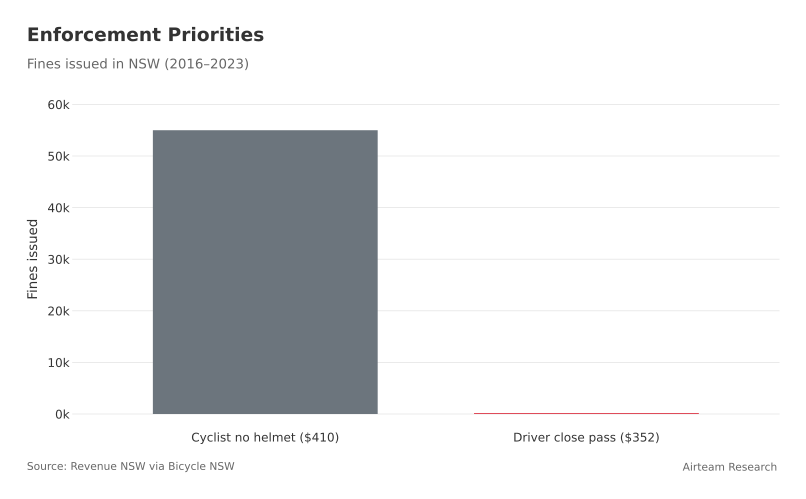
Figure description: A comparison table showing fine amounts and enforcement volume for cyclist self-protection offences versus driver offences that endanger cyclists.
| Comparison criteria | Fine | Demerits | Who Bears Risk | Fines Issued (2016–2023) |
|---|---|---|---|---|
| Cyclist riding without helmet | $410 | 0 | Cyclist only | ~55,000+ |
| Driver close pass (MPD violation) | $352 | 2 | Cyclist | 171 |
| Ratio | — | — | — | 322:1 |
Source: Revenue NSW via Bicycle NSW
The Minimum Passing Distance law has been in effect since 2016. It requires drivers to leave at least one metre when passing a cyclist at speeds up to 60 km/h, and 1.5 metres above that speed. In seven years, 171 fines have been issued.
Over the same period, cyclists received approximately 55,000 fines—predominantly for helmet non-compliance. The fine for not protecting your own head ($410) exceeds the fine for endangering someone else's life ($352).
This is not an argument against helmet laws. It is an observation about where enforcement resources are directed.
What the data suggests
The figures above point to a small set of conclusions and, therefore, a small set of practical policy questions.
1. Measure harm properly (and publish it). When 89.5% of serious cyclist injuries are missing from police-reported crash data, decisions based on that dataset will be made on a partial picture. Hospital admissions exist; systematic linkage and routine publication would make VRU harm visible.
2. Treat 50 km/h as a safety setting, not a default. Most VRU crashes occur in 50–60 km/h environments (69.2%), and fatality rates rise steeply with speed zone. The zero-fatality record in ≤30 km/h zones (in the crash dataset) suggests that urban speed defaults deserve re-examination - especially where walking and cycling are concentrated.
3. Match investment to exposure and demographics. Cycling participation has grown, particularly among middle-aged and older Australians. Injury burden has grown faster. The gap between infrastructure provision and need appears to be widening.
4. Align enforcement with harm reduction. A 322:1 ratio between cyclist helmet fines and Minimum Passing Distance fines raises a simple question: are enforcement resources targeting the behaviors most associated with severe outcomes?
These are not abstract debates. They are choices about what NSW measures, what NSW builds, and what NSW enforces.
A note on method
The statistics in this piece are drawn from official sources: Transport for NSW crash data, the Bureau of Infrastructure and Transport Research Economics (BITRE), NSW Health hospitalisation records, and the Australian Institute of Health and Welfare. Where calculations have been performed such as capture rates or representation factors the methodology is documented.
Data has limitations. Small samples produce unstable rates. Fatality counts fluctuate year to year. COVID-19 altered travel patterns between 2020 and 2022. These caveats matter.
But the broad pattern is consistent across multiple data sources and time periods: vulnerable road users face substantially higher risk, that risk is inadequately captured in official statistics, and the gap between car occupant safety improvements and VRU safety improvements continues to widen.
The question
Road safety policy in NSW has delivered meaningful improvements for car occupants over 25 years. The same cannot be said for pedestrians, cyclists, and motorcyclists.
NSW already collects much of the evidence needed to understand that divergence. The question is whether there is willingness to act on it.
The author acknowledges the complexity of road safety policy and the genuine progress made in overall fatality reduction. This analysis focuses specifically on the divergent outcomes for vulnerable road users—a pattern that warrants attention regardless of one's views on transport policy.