AI scribes: 13 of 28 Australian platforms list one, and two in five GPs already use one
We counted the AI scribes on every Australian practice management platform we track, and read the clinical evidence behind them. The time savings are measured. The responsibility is not moved.
In August 2024, 22% of GPs polled by newsGP said they used an AI scribe. By November 2025 it was 40%, and the RACGP has said that figure is conservative. Nothing else in practice technology has moved that fast since online booking.
Two in five GPs now use an AI scribe, and the RACGP calls that figure conservative.
The integration lists agree
We counted the integrations on the 28 Australian platforms in our comparison on 30 October 2026: 13 list at least one AI scribe, 27 listings across roughly 11 distinct products. Heidi alone appears on 11 platforms. Three weeks earlier, when we ran the same count for our first AI-workers article, Heidi appeared on three.
The money agrees. Heidi raised $340 million in September 2026 to move beyond writing notes into supervised actions around the visit. The scribe category is not a passing experiment.
What the scribe studies show
A JAMA study published in April 2026, run across five academic medical centres, found clinicians using ambient scribes spent 16 minutes less on documentation per encounter and 13.4 minutes less in the EHR overall.
Australian evidence now exists. An Australian Journal of General Practice study (April 2026) compared four commercial scribes against human documentation on simulated RACGP exam cases, rated by three blinded GPs. The best scribes scored higher than the humans, 44.08 out of 50 against 37.42, and every product showed a distinct weakness somewhere else. A separate evaluation of the Lyrebird scribe at Gold Coast Hospital and Health Service, 100 clinicians and 7,499 consultations over 16 weeks, found most generated text survived into the final record, and found hallucinated output too.
The wellbeing claims are weaker than the time claims. One multicentre study in JAMA Network Open found physician burnout fall from 51.9% to 38.8% over 30 days of scribe use. Sutter Health's Abridge rollout across 100 clinicians found a 7% burnout reduction that was not statistically significant. Across the literature: scribes give back real time, the burnout evidence is promising but mixed, and no study claims the tools are error-free.
Consent comes before every recording
Every Australian guidance body that has looked at scribes lands in the same place: the patient consents, and the doctor stays responsible.
Ahpra, the RACGP and Avant all require informed patient consent before an AI scribe records a consultation: the patient understands the scribe records the visit, a third party processes the audio, and they can opt out. In some jurisdictions, recording without consent is a criminal offence, which is why the guidance says to ask every time, not once at intake.
The privacy law treats the scribe's input and output the same way. The Office of the Australian Information Commissioner considers anything entered into an AI tool, and anything it generates, to be collected health information under the Privacy Act. Most scribe vendors are based overseas, which makes the practice responsible for cross-border disclosure under APP 8. And most generative scribes are not TGA-classified medical devices, so no device regulation applies to them.
Doctors remain responsible for the accuracy of all health information collected or generated by AI.
Your platform picks your scribe
The scribe a practice can buy is bounded by the platform it already runs, because a scribe needs the patient record and the schedule to be useful.
Our count on 30 October 2026: Heidi is listed on 11 of the 28 platforms, including Cliniko, Genie, Gentu, Halaxy, Nookal and Zedmed. Lyrebird Health appears on three (BP Premier, Genie, Gentu). i-scribe appears on Genie and Shexie. BP Premier's list carries six scribe or voice products, including MedTalk and Dragon Medical One. Some allied-health platforms list none at all.
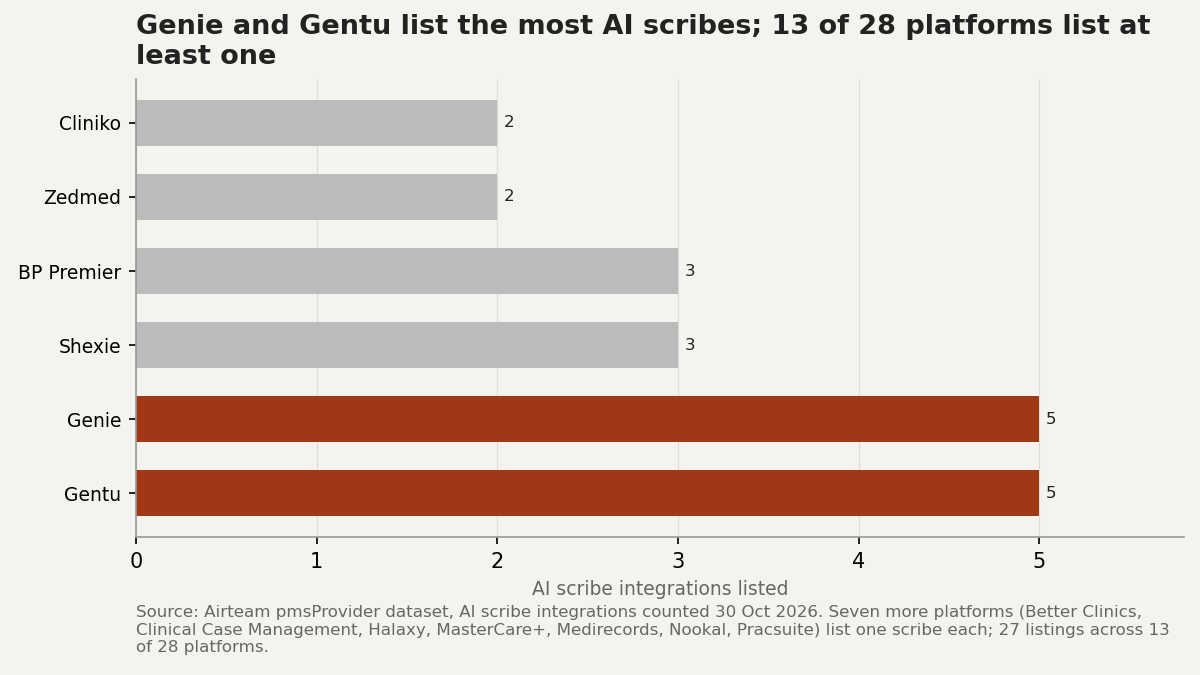
That makes the scribe choice mostly a platform choice. A scribe writing straight into the record saves a copy-paste step and an error path. Sitting beside the platform, it does less, and often costs the same.
Four checks before switching one on
Consent, every consultation. The privacy policy discloses AI use, the patient consents before the scribe records, and the consult can proceed without the scribe when they decline.
Data residency and APP 8. Where are the audio and transcripts stored, for how long, and is the vendor overseas? Ask for the data processing agreement before the demo.
Model training. Ask whether patient data can train the vendor's models, and whether an opt-out exists on your plan.
The error path. The doctor signs the note, so the workflow must end with a human reading it. The Gold Coast evaluation found hallucinated output in a well-run deployment. Decide who fixes a wrong note before the tool goes live.
The platform choice is the scribe choice
Scribes went from curiosity to default in a year. The savings are measured, and the responsibility for the note has not moved. Which scribes a practice can buy was decided when it chose its platform. The comparison table records the full integration list for all 28. Read it before the demo.
For the wider picture, read AI practice management software and the practice management software comparison behind it.
Building an AI-ready practice starts with the platform decision. Get in touch if you want a second opinion on yours.
About the data
Platform counts come from the Airteam pmsProvider dataset, a human review of each vendor's website, counted across 28 platforms on 30 October 2026. Clinical findings: JAMA (April 2026), JAMA Network Open (2025), the Australian Journal of General Practice (April 2026), and the Gold Coast Hospital and Health Service evaluation of Lyrebird, which is vendor-reported. Guidance: the published positions of Ahpra, the RACGP, Avant, the Office of the Australian Information Commissioner and the TGA.