AI practice management software: 10 of 28 Australian platforms already list AI tools
We counted the integration lists of every Australian practice management platform we could find. The AI products are already there, as tenants of the platforms they were predicted to replace.

We counted the integration lists of every Australian practice management platform we could find. The AI products are already there, as tenants of the platforms they were predicted to replace.
AI products have arrived on a third of the market
Ten of the 28 platforms in our comparison list at least one AI product: a scribe that drafts the clinical notes, or a receptionist that answers the phone and books appointments. Across 557 recorded integrations, that is 24 AI integrations across roughly 18 distinct products.
The prediction had run the other way. Software commentators spent two years arguing that AI point solutions would take the platform's jobs one at a time, scheduling first, documentation next, until the practice management system was an empty shell. We run the comparison of 28 Australian practice management platforms, and we counted what happened instead: the AI products arrived on the platforms' terms, inside the integration directories.
Some of the names repeat. Heidi appears on three platforms (Better Clinics, Cliniko and MasterCare+). i-scribe appears on three (Genie, Gentu and Shexie). Cliniko's directory alone lists eight AI products, four of them AI receptionists. Two years ago this product category barely existed.
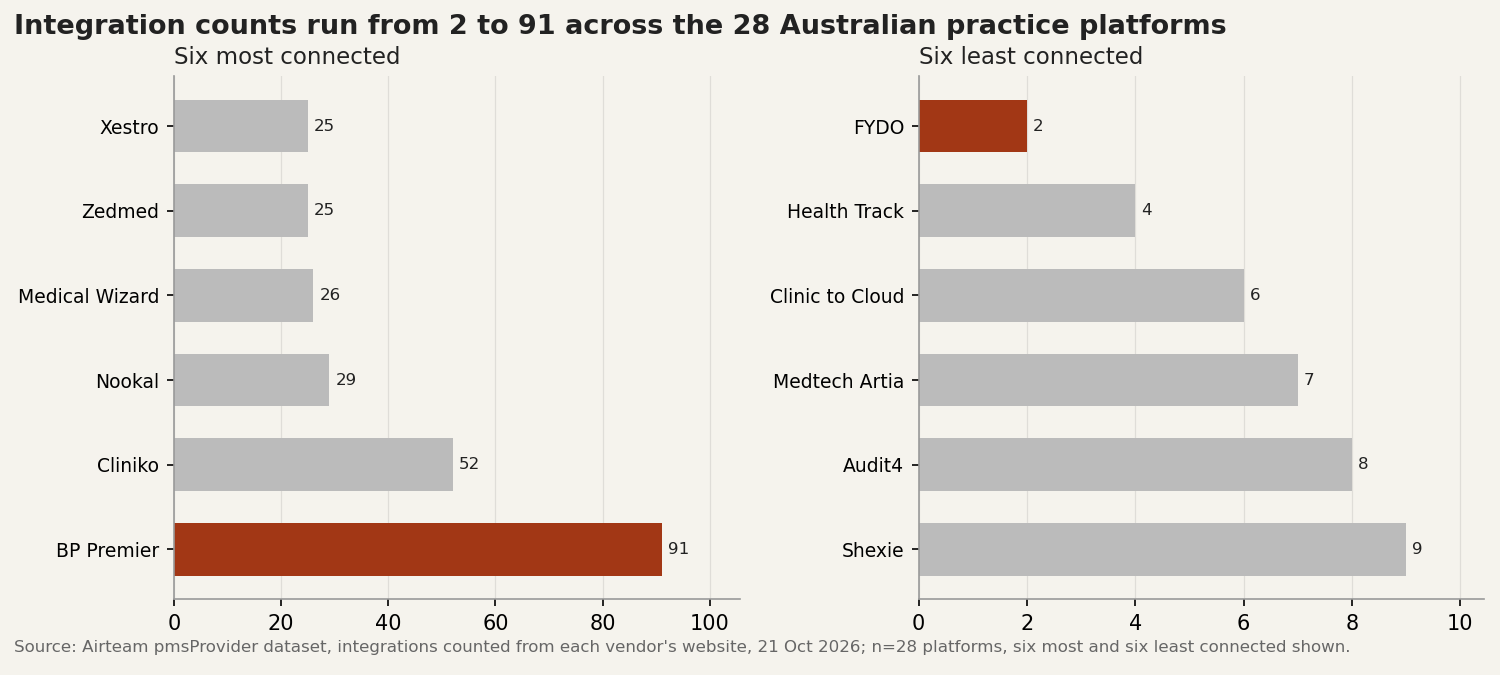
The six most and six least connected of the 28 platforms. Source: Airteam pmsProvider dataset, integrations counted from each vendor's website, 21 Oct 2026.
The integration list is now an AI-readiness score
The integration list decides which AI tools a practice can hire, because an AI tool cannot do its job without the platform. A scribe that cannot write to the patient record is a voice recorder. A receptionist that cannot see the schedule books nothing. Every AI product on those lists depends on the two things only the practice management system holds, the patient record and the appointment book.
That dependency shows up in the integration counts. BP Premier lists 91 integrations. Cliniko lists 52, Nookal 29. At the other end, FYDO lists 2 and Clinic to Cloud 6. We first read that spread as a lock-in debate. With AI tools joining the directories, the breadth of a platform's integration list now decides which AI products a practice can even consider.
The same pattern predates AI in the booking layer. HealthEngine integrates with 11 of the 28 platforms and HotDoc with 8, which means most practices never chose their booking layer either. The platform's directory made the choice.
What the clinical evidence shows: 16 minutes back per encounter
The clinical evidence on scribes is now measured in minutes. A JAMA study published in April 2026 ran across five academic medical centres. Clinicians using ambient AI scribes spent 16 minutes less on documentation per encounter and 13.4 minutes less in the EHR overall. An earlier multicentre study in JAMA Network Open found physician burnout fell from 51.9% to 38.8% over 30 days of scribe use. KLAS reported in 2025 that more than 70% of large US health networks have deployed or are actively piloting an ambient scribe.
Not every result is clean. Sutter Health's rollout of the Abridge scribe across 100 clinicians found a 7% burnout reduction that was not statistically significant. The time savings hold up better than the wellbeing claims. What the evidence supports is narrower than the vendor pitches: scribes give clinicians back real time, and the burnout evidence is promising but mixed.
Privacy obligations apply to any personal information input into an AI system as well as the output data it generates.
Who answers when the AI tool gets it wrong
The integration directories stay silent on responsibility. The law does not. The scribe drafts the note, and the doctor signs it. The Medical Journal of Australia's guidance is direct: doctors remain responsible for the accuracy of all health information collected or generated by AI. The Office of the Australian Information Commissioner treats anything entered into an AI tool, and anything it generates, as collected health information under the Privacy Act.
The receptionist carries a different risk. Confirming to an unverified caller that someone is a patient is a privacy breach, and an AI receptionist has no way to verify a caller over the phone. Most of these products record and transcribe calls, and the consent rules for recording vary by state; in some states, recording a private conversation without consent is a criminal offence. Vendors and insurers converge on one practical answer: disclose the recording on every call, everywhere.
Two more gaps sit underneath. Most generative scribes are not classified as medical devices by the TGA, so no device regulation applies to them. And most AI vendors are based overseas. Sending patient data to an overseas vendor is a cross-border disclosure under APP 8 of the Privacy Act, and the practice carries the obligation to check what happens to it.
Five checks before switching on an AI tool
First, consent and disclosure. The practice privacy policy should disclose AI use, patients should consent before the tool collects their health information, and calls should be disclosed as recorded on every call.
Second, data residency. Where are transcripts stored, for how long, and is the vendor overseas? An overseas vendor triggers APP 8. Ask for the data processing agreement.
Third, model training. Ask whether patient data can be used to train the vendor's models, and whether an opt-out exists on your plan.
Fourth, the error path. The doctor signs the note, so the workflow must end with a human reading it. Decide who fixes a wrong note before the tool goes live.
Fifth, integration depth. Does the product write to the patient record and the schedule, or does it sit beside them? A product that only sits beside them does less, and costs the same.
Doctors remain responsible for the accuracy of all health information collected or generated by AI.
The platform choice is now the AI choice
The platform choice a practice made years ago now decides which AI tools it can hire. AI tools need the record and the schedule. The platform holds both.
The comparison table records deployment, data storage, security and the full integration list for all 28 platforms. Read the integration list before the demo.
Airteam builds AI tools into the software health organisations already run: the integration, the consent flow, the data residency and the error path, designed in from the first commit. If that is the work in front of you, get in touch.
About the data
Sources: the Airteam pmsProvider dataset (28 platforms, integrations counted from vendor websites, 21 October 2026); the JAMA study of ambient AI scribes, April 2026; JAMA Network Open, 2025; KLAS Ambient Speech Performance, 2025; MJA InSight on AI tools and patient data privacy; Avant on AI scribes and patient consent; OAIC guidance on privacy and commercially available AI products. Every figure traces to its source in the research brief.