Data centre locations: the Hunter has the good sites, and the clean-up should buy the town more than a tidy pit
Australia is about to build more data centre capacity than it ever has. The siting decisions now being made will decide whether the Hunter Valley gets a second act or a second industrial scar.
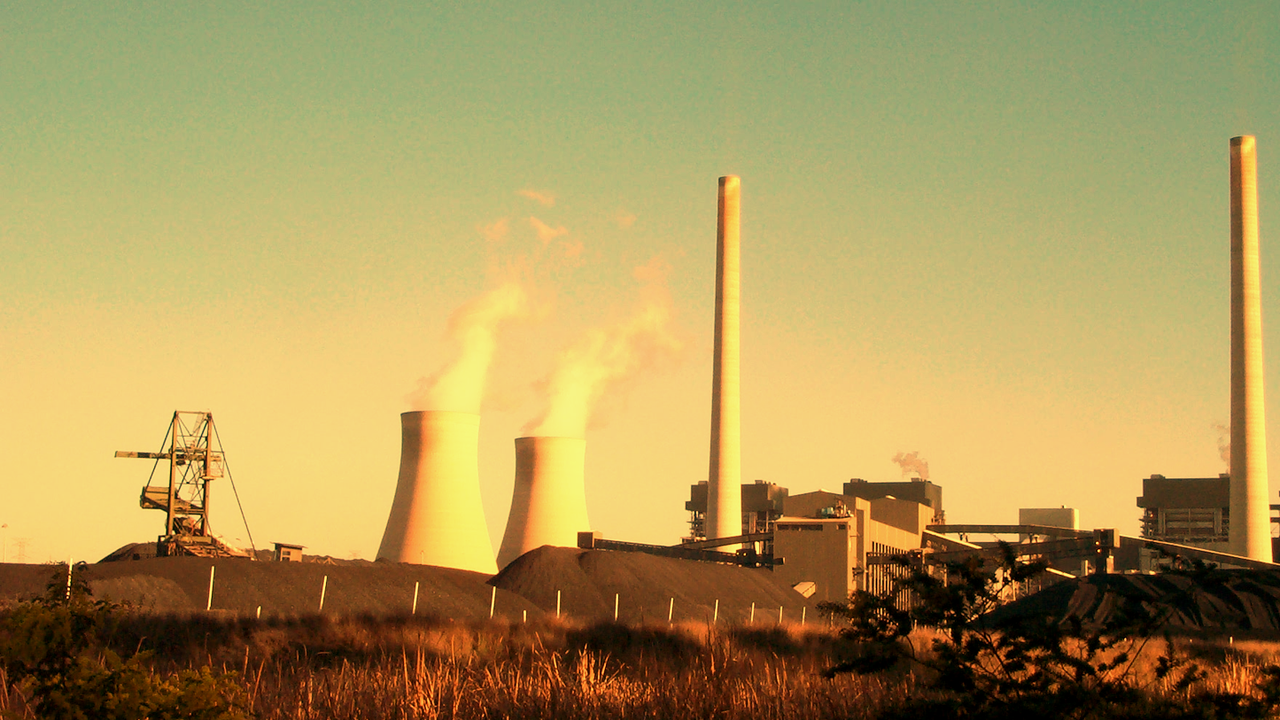
Australia is about to build more data centre capacity than it has ever built. The siting decisions now being made will decide whether the Hunter Valley gets a second act or a second industrial scar. The Commonwealth Bank estimates the national build-out could reach A$260 billion over roughly a decade. Anthropic has told the NSW government it wants up to 5 gigawatts of AI capacity in this state, more than triple what the entire country operates today. The question in front of planning decision-makers and the communities next door is not whether these buildings get built. It is where, and on what terms.
Power, land and consent decide the site
Power decides a data centre site first, and the numbers put Sydney last. Bloomberg reviewed the 40-plus large data centres planned or under construction around Sydney and Melbourne, a pipeline of more than A$100 billion. Only 23 per cent had publicly confirmed an electricity supply or grid connection.
Transgrid's connections pipeline carries at least 6 gigawatts of data centre applications against an estimated 1.2 gigawatts of additional Sydney load arriving by 2030. A project that cannot get energised is a rendering.
The Hunter starts where Sydney is stuck. The transmission lines around the retired Liddell station, Muswellbrook and Bayswater run at 27 to 28 per cent utilisation. Transgrid's 2025 planning report lists no prescribed network augmentations for the Newcastle and Central Coast region over the next decade. The wires the coal fleet leaves behind are the asset. The land is the second asset: flat, cleared, already-disturbed ground in volumes a city site cannot offer, with Mt Arthur's open-cut footprint alone covering around 7,000 hectares.
Consent decides third, and it is not a soft factor. In a single quarter of 2026, local opposition in the United States disrupted 45 data centre projects worth US$68 billion. Sydney and Melbourne host about 80 per cent of Australia's data centre capacity, and the backlash is arriving with the growth. A site that replaces coal jobs with compute jobs walks into the approval process with the argument already made.
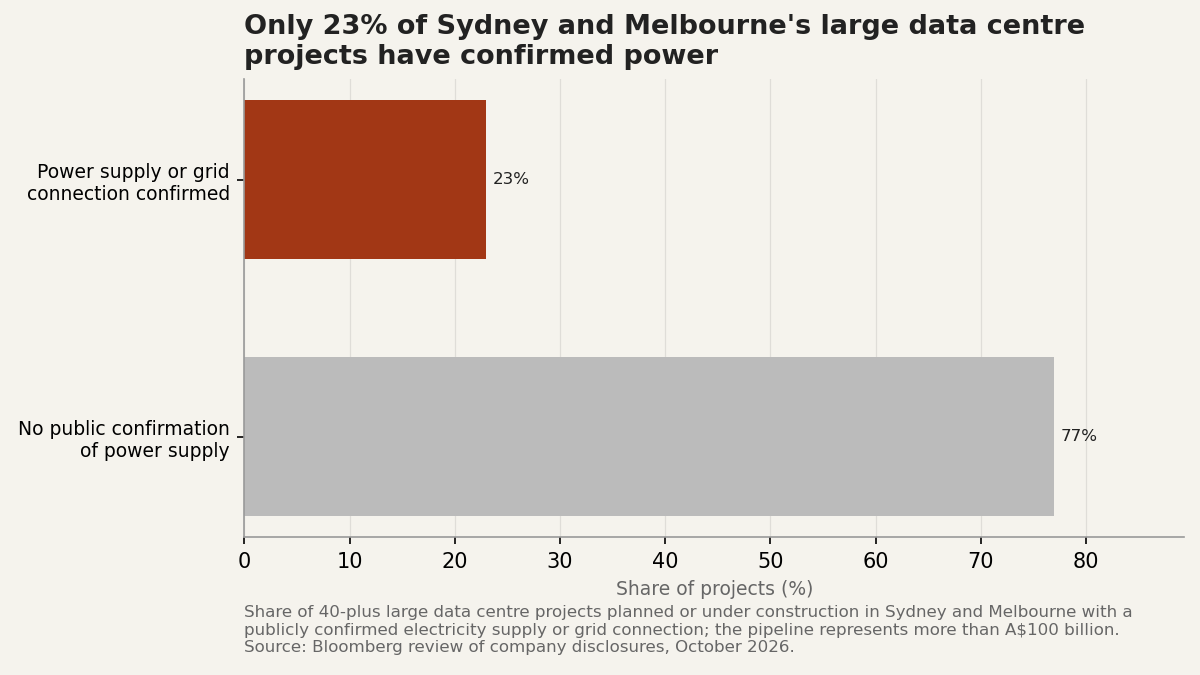
Confirmed power supply across the 40-plus project Sydney and Melbourne pipeline. Data: Bloomberg review of company disclosures, October 2026.
The worst site is the one without confirmed power
The worst address in the country right now is a metropolitan site with no confirmed connection: the demand is there and the power is not, and the queue is years long. A greenfield rural site fails differently: the land is cheap and the wires are missing, and new transmission is the multi-year critical path everywhere in the National Electricity Market.
A site that leans on gas as its base fuel inherits the Kurri Kurri lesson. Snowy Hydro's 660 megawatt peaker arrived more than two years late, at more than double its original cost. East coast gas trades at export parity, about 9.05 dollars a gigajoule against roughly 12 dollars per megawatt-hour equivalent in the United States. Solar and wind are the cheap energy, at 21 to 50 and 54 to 94 dollars per megawatt-hour by 2030 on CSIRO's numbers. The site that can host them and firm them wins.
The amenity condition on legacy industrial sites
If a proposal lands on an old mine or a retired power station, the developer is buying a subsidy the community built. The transmission, the substations, the access corridors: all paid for by decades of coal. The clean-up is the entry ticket, and it should buy the town more than compliance with the closure plan.
The approved closure plan for Mt Arthur has woodland and agriculture as the dominant post-mining land uses, with permanent final voids in the final landform. That is the legal baseline. The community should expect the baseline plus amenity, and the mechanisms exist. Rehabilitated land can return as public recreation and habitat in the woodland and agriculture the closure plan already names. Voids can become assets the town uses, the way AGL and Idemitsu have proposed a 400 megawatt pumped hydro scheme in the Muswellbrook pit. The campus can carry community energy, rate revenue and local jobs with a training pipeline attached.
The Pennsylvania precedent shows what a campus will pay for land with power attached. Aligned Data Centers paid about US$223 million for 651 acres at the former Bruce Mansfield coal station site, then started a roughly US$10 billion, 2 gigawatt build. A hyperscale project in Australia runs past A$2.5 billion on average. Against that, a nine-figure rehabilitation-plus-amenity package sits in the low single digits as a share of project cost (estimate, order of magnitude only; no specific Hunter rehabilitation provision was priced for this piece). The Muswellbrook solar farm, approved on the former Muswellbrook coal mine inside the Hunter-Central Coast Renewable Energy Zone, shows the planning system already accepts the trade.
In NSW, rehabilitation liabilities and financial assurance transfer to the new titleholder when a sale is approved, so whoever takes the land owns the obligation. What the transfer does not automatically buy is the amenity above the baseline, because closure criteria gate the land and the town's wishes sit outside them. That gap is exactly what approval conditions are for.
The amenity-gain test for approval conditions
A good data centre site has surplus power, usable land and a community that gains. The Hunter has the first two in quantities no city site can match. The third is the community's to set, and it should be set as a condition. Approval on a legacy industrial site carries an amenity-gain requirement: rehabilitation to the legal standard plus named, funded improvements the town keeps.
Public access to rehabilitated land is conditionable. Voids working as storage or lakes are conditionable. A rates and jobs package with numbers attached is conditionable. Each has a working precedent somewhere in the valley already.
The developers who need sites will pay it.
Sources
Bloomberg, AI Data Center Backlash Threatens Australia's $70 Billion Dream.
Climate Council, Managing the Risks of the Data Centre Boom.
United States Studies Centre, Powering the Cloud: Data Centres and the Future of Australia's Grid.
Follow the Bottleneck, Hunter Region Data Centres: NSW's Spare Grid Capacity (citing Transgrid Transmission Annual Planning Report 2025).
AMP Econosights, Five Things That Could Stop the Data Centre Boom.
CSIRO, GenCost 2025-26.
Snowy Hydro, Kurri Kurri Power Station; WattClarity, A Sorry Chronology of the Hunter Power Station.
BHP, Mt Arthur Coal Rehabilitation Strategy and Powering What's Next.
Renew Economy, Contested Hunter Valley Solar and Battery Project Approved.
Data Center Frontier, From Coal to Compute: How Pennsylvania Is Rebuilding Power for AI Data Centers.
GlobeNewswire, Range Impact Land Acquisitions in Kentucky.
SERS, Australia Mine Closure Laws 2026.
AGL, Liddell Battery Commissioning Milestone.
Energy Monitor / PV Tech, Origin to Extend Operation of Eraring Power Station.