How Japanese households came to get a better deal on Australian gas than Aussie households
Australia is the world's second-largest LNG exporter. Its wholesale gas is priced at what the exporters could earn overseas, its export producers are mostly foreign-owned, and its households pay more than Japan's.
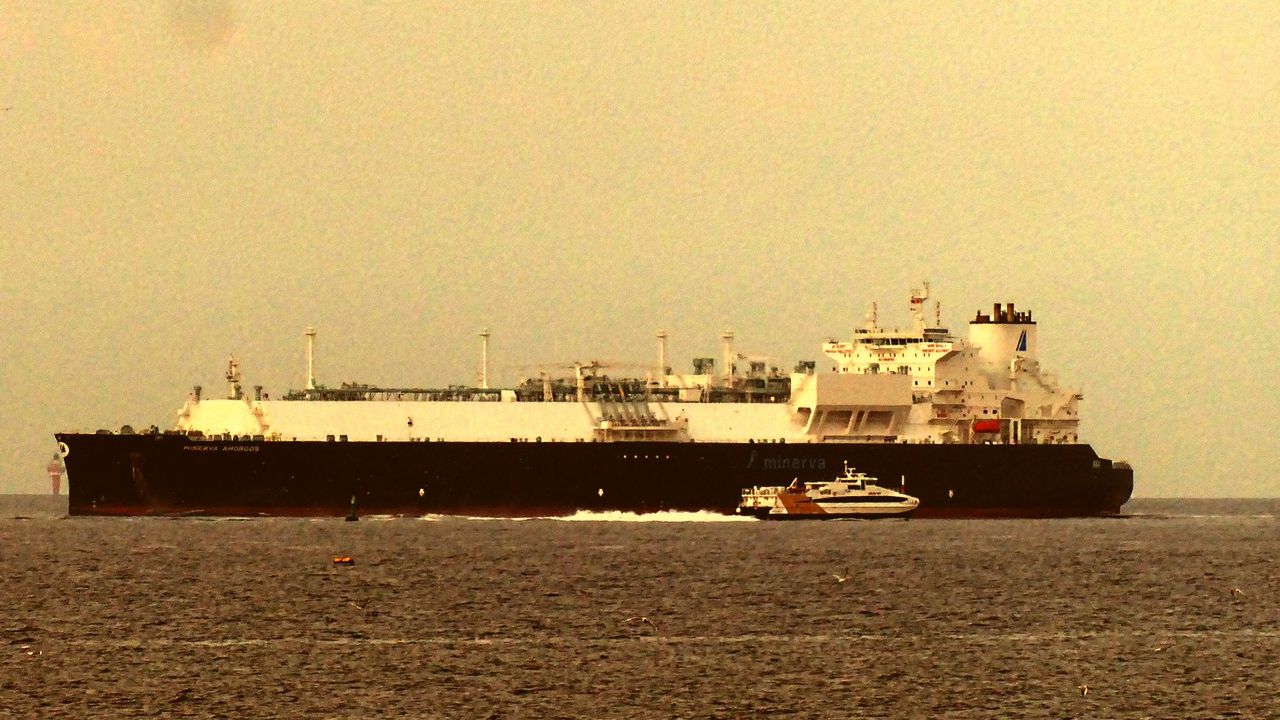
Australia shipped 26 million tonnes of LNG to Japan in 2024, 35 per cent of its exports in the first half of this year. Japan's price is landed: it bundles the gas with liquefaction, shipping, and the receiving terminals. The seller's gas comes out of the ground off its own coast; none of those costs apply.
In 2010 the seller got a discount
In 2010 a Sydney household paid 95 US dollars per MWh; a Tokyo household, importing every megajoule, paid 142. Today the Sydney series we built from the consumer price index puts the household at 148, against Tokyo's effective 142 on its published regulated tariff. The seller now pays more than the buyer.
The price ladder
The gas changes hands for 22.70 US dollars per MWh on the Australian wholesale spot market and 37.90 landed in Japan. The Tokyo household pays 3.8 times the landed price; the Sydney household, 6.5 times its own wholesale price. That spread is mostly pipes: distribution and transmission are over half of a residential gas bill.
The unusually large margin sits at the producer level
East coast contracts run at 12 to 15 dollars a gigajoule against a Reserve Bank cost estimate of 7 to 8 for new supply. Exports earned 15.65 over the year to June 2026, 55 per cent more than the 10.07 domestic customers paid. And in Western Australia, which has reserved gas for domestic use since 2006, the same producers sell at 5.84, half the east coast price.
Wholesale prices are set by export parity, not cost, and the Commonwealth's reservation policy, announced in May 2026, is an attempt to fix exactly that.
The protections are all younger than the problem
The Australian Domestic Gas Security Mechanism (2017) lets the government limit exports in a shortfall year. The December 2022 price cap set 12 dollars a gigajoule for new wholesale contracts, but the ACCC estimates more than 90 per cent of gas sold is exempt from it. In May 2026 the Commonwealth announced the east coast reservation: 20 per cent of export volumes set aside for domestic buyers from mid-2027.
Perth shows what that fix reaches and what it does not: WA's wholesale gas is half the east coast price, yet Perth households pay 165 dollars per MWh, more than Sydney's, because the bill built on top of the wholesale is mostly network charges.
Are consumers being ripped off?
No link in the chain is breaking a rule, and that is the point. Producers price domestic gas at their opportunity cost, the LNG netback, and nothing pulls the price below it: the three Queensland exporters and their associates control 84 per cent of the east coast's viable gas, new entrants face significant barriers, WA's cheap gas cannot flow east, and the market runs short every winter.
The gas belongs to the public, but the act of parliament meant to return the public's share, the Petroleum Resource Rent Tax, collected nothing from LNG projects until the 2024 deductions cap began to bite: Australians pay the export price at the meter and collect almost none of the rent.
At a cost-based wholesale price, household bills fall about 10 per cent; industrial buyers save 26 to 42 per cent. Whether that is being ripped off is a judgment; the transfer and the mechanism are measured.
The household wedge
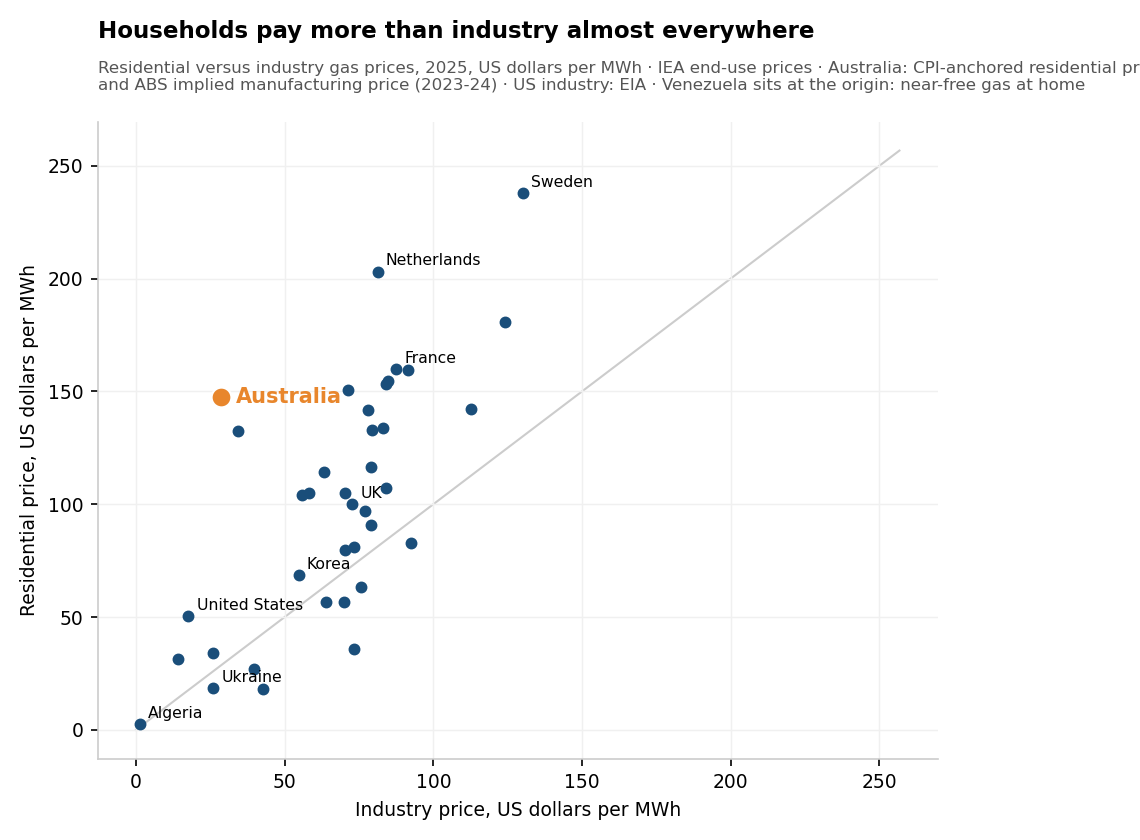
The wedge is the policy story in one picture. Japanese households pay about what Japanese industry pays: both sit near the diagonal. Australian households pay five times their own industry price, the widest gap of any country with a working market, because the wholesale is set at export parity and the network bill stacks on top of it whole.
The points at the origin are the producers' states: Venezuela and Algeria give gas away at home. The points far above the diagonal are where households pay the export-parity wholesale plus the full network bill: Australia, Sweden, the Netherlands.
About the data
The 44-country panel comes from the IEA's End-Use Energy Prices (free selection) at 2000, 2010 and 2025; the Sydney series splices the ABS consumer price index for gas to the national series before 2022 and anchors it to the 2017 Oakley Greenwood review of NSW tariffs; the Tokyo and Perth figures are effective rates computed from the published regulated tariffs. Every number checkable against the source data.
Australian manufacturers, who pay near wholesale, get 29 US dollars per MWh, half what Japanese industry paid in 2010: export parity lifted industrial prices without carrying them to the buyer's level.
If your organisation's data needs this treatment, get in touch.
Sources
Every figure traces to one of these sources.
- Tokyo Gas, regulated gas tariff, Oct 2026: https://home.tokyo-gas.co.jp/gas_power/plan/gas/basic.html
- IEA, End-Use Energy Prices, free selection: https://www.iea.org/data-and-statistics/data-tools/end-use-prices-data-explorer
- ABS, Consumer Price Index, gas series: https://www.abs.gov.au/statistics/economy/price-indexes-and-inflation/consumer-price-index-australia
- ABS, Energy Account Australia 2023-24: https://www.abs.gov.au/statistics/industry/energy/energy-account-australia
- Oakley Greenwood, Gas Price Trends Review, 2017: https://oakleygreenwood.com.au/wp-content/uploads/2017/12/gas-price-trends-report.pdf
- Energy Institute, Statistical Review of World Energy 2026: https://www.energyinst.org/statistical-review
- IGU, World LNG Report 2025: https://igu.org/resources/world-lng-report-2025/
- ACCC, Gas Inquiry 2017-30 interim reports: https://www.accc.gov.au/about-us/publications/serial-publications/gas-inquiry-2017-30-reports
- EnergyQuest, gas price movements, June 2026: https://energyproducers.au/hubfs/EnergyQuest%20-%20international%20and%20domestic%20prices%2025%20June%202026.pdf
- RBA Bulletin, east coast gas market, March 2021: https://www.rba.gov.au/publications/bulletin/2021/mar/pdf/understanding-the-east-coast-gas-market.pdf
- AER, State of the energy market 2024: https://www.aer.gov.au/system/files/2025-07/State%20of%20the%20energy%20market%202024.pdf
- ABC News, reservation policy, 7 May 2026: https://www.abc.net.au/news/2026-05-07/east-coast-gas-reservation-policy-announced-to-avert-shortages/106651532
- GlobalPetrolPrices.com, gas prices, March 2026 (cross-check; its consumption assumption reads low): https://www.globalpetrolprices.com/Japan/natural_gas_prices/