Case study
MunchMonitor
How MunchMonitor made school lunch ordering easy with a new mobile app
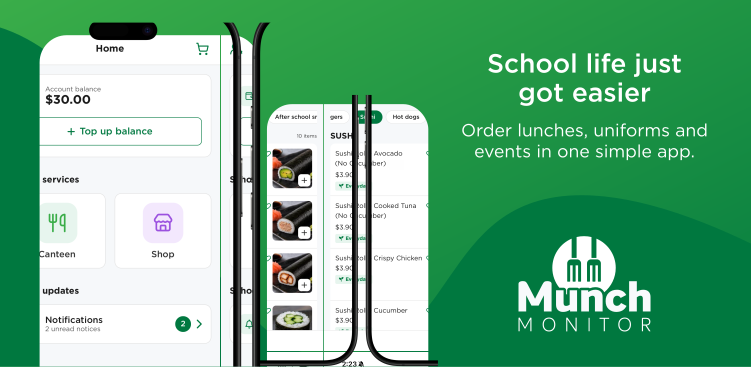
Parents told MunchMonitor its web-based ordering felt clunky on a phone. Three months later, they had a native app that sparked a surge of downloads and customer leads.
Picture a parent ordering school lunch on their phone at 8:15am. They’re pinching and zooming through the canteen menu when a child announces their shoe is missing - just as the dog proudly appears with it in its mouth.
The phone gets pocketed. The shoe gets rescued. By the time they return to the lunch order, the session has timed out.
Ouch.
For parents using MunchMonitor on their phones, interruptions like this exposed a bigger problem: the ordering experience hadn’t originally been designed around mobile.
It had also become a sticking point for some schools in MunchMonitor’s sales pipeline.
Chanae Raso, MunchMonitor’s Business Improvement Project Manager, had heard these frustrations directly from parents:
"The feedback we were getting from our parents was: 'It's a little bit clunky to have to log into a website on my mobile browser.'"
Quick facts
In three months, MunchMonitor went from a browser-based mobile experience to a dedicated app for iOS and Android. The app recorded more than 550 downloads within two days, generated 43 new school leads at an industry conference, and gave MunchMonitor a stronger foundation to build on.
- Client: MunchMonitor, part of Countrywide Australasia Limited
- Industry: Education technology and school services
- Our services: Custom software design and development, UX research and design, custom mobile app development, prototyping, testing, and delivery
Why MunchMonitor needed a better mobile experience
MunchMonitor has been providing online ordering for school communities for around 15 years. But the way parents access digital services has changed significantly over that time.
For many parents, mobile is now their primary device. In the age of menu delivery apps such as Uber, parents are accustomed to no-fuss ordering experiences.
MunchMonitor’s existing platform had not originally been optimised around that behaviour, which meant parents ordering lunch on a phone still needed to use a mobile browser.
"Part of our development strategy," says Chanae, "was to take us a little bit into the 21st century with some of our technology users.
"The majority of our parents… their mobile is their go-to device."
Three months to go live
MunchMonitor selected Airteam following a competitive RFQ process to design and develop a cross-platform app for iOS and Android.
There was a clear deadline: the app needed to be ready in time for the school semester.
That gave MunchMonitor and Airteam three months to move from discovery through to launch.
The timeline meant making deliberate decisions about where to focus. The app needed to integrate with MunchMonitor’s existing platform and backend systems, preserve the functionality parents already relied on, and keep school and student data stored in Australia.
MunchMonitor and Airteam also wanted to avoid simply recreating the existing browser experience inside an app.
“We weren’t going out with just a subpar app that was exactly the same as our web experience,” says Chanae.
Working closely in person helped both teams resolve requirements quickly and keep decisions moving.
“It felt a little bit more like we were on the journey together,” says Chanae.
“You guys are a high touch point. You were very communicative, and understood our requirements, probably better than your competitors in the sense of how much you guys investigated and delved deeper into MunchMonitor.”
Designing around how parents actually order
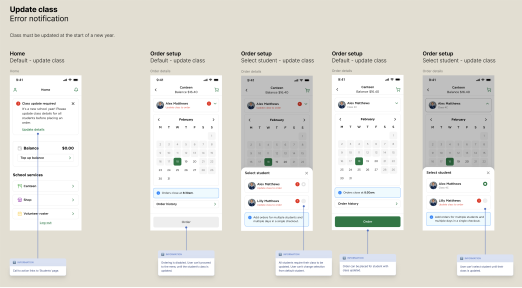
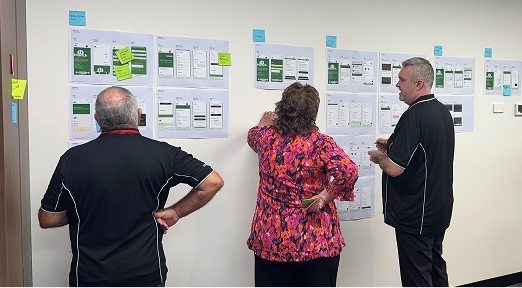
Before designing screens, Airteam Senior UX Designer Jason Robertson mapped the competitive landscape, existing user flows and the different ways school communities use ordering platforms.
Discovery workshops brought MunchMonitor, Airteam and teachers together to examine the existing experience across registration, ordering, payments and account management.
The sessions also highlighted an important constraint: school communities do not all behave in the same way. Requirements can vary depending on factors such as location and whether a school is public or private.
Together, the teams reviewed existing user journeys, competitor approaches and familiar consumer experiences such as Uber Eats. This created a clearer picture of what needed to be delivered immediately and what could sit on a longer-term roadmap.
Rather than designing only for the initial release, the team also considered how MunchMonitor might extend the app later without having to rethink its foundations.
“The idea was to look holistically at where MunchMonitor wanted the app to be in the future,” says Jason.
“We ended up building out a whole list of options they could choose from, which they could implement now if it was in budget, scope, and timeframe, or they could put them in a future roadmap.”
One codebase, two platforms
The three-month deadline also shaped the technical approach.
Airteam Senior Full Stack Developer Tim Wei and the development team chose a cross-platform architecture so a single codebase could support both iOS and Android. This reduced duplicated development effort while giving MunchMonitor a more maintainable foundation for future enhancements.
Design and development also ran in parallel rather than as consecutive stages.
A rapid testing and deployment process meant new builds could be released, tested and refined throughout development instead of waiting until the end of the project.
“Sometimes we just released a new patch every day,” says Tim. “Every day we had something resolved, and every day we got new things to test.”
More than a mobile version of the website
The initial goal was to give parents the functionality available through MunchMonitor’s web platform in an experience designed around mobile.
The finished app went further.
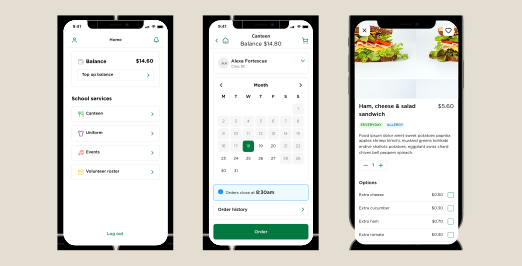
Parents can sign in using Face ID, Touch ID or fingerprint recognition rather than repeatedly entering credentials. Deep links can take users directly from account emails into the app, while background cart sync and resilient sessions allow interrupted orders to be resumed later.
Parents can also manage orders for multiple children using individual profiles and saved meal favourites, pay using their account balance or cards, shop for school essentials and access school news from the same app.
For Chanae, the additional thinking around the user journey was an important part of the project.
“You guys came in with some really great ideas off the bat, which meant we didn’t have to think of it,” she says.
“We weren’t going out with just a sub-par app that was exactly the same as our web experience. If anything, we brought in enhancements in what we were originally expecting to just be a levelling platform.”
One of the simplest changes also became one of the most noticeable for parents.
“All I have to do is look at it and I’m in,” says Chanae, describing feedback on biometric login.
Building a foundation MunchMonitor can extend
The project was designed around the first release, without treating that release as the end state.
Airteam’s Head of Operations Ben Mullaley says expandability remained a consideration throughout delivery.
“We have a big backlog of items, new features, and enhancements that MunchMonitor can make,” says Ben.
“All of the time it was in the back of our mind that it’s got to be expandable. It’s got to be a good foundation to build on.”
550+ downloads in two days
The early response gave MunchMonitor a strong signal that the mobile experience was meeting an existing customer need.
Within two days of launch, the app recorded more than 550 downloads on Apple’s App Store.
That came from an initial communication to around 8,000 parent users. A further 42 schools, representing approximately 22,000 users, had not yet been notified.
Early customer feedback was similarly positive.
“Every single piece of feedback was that the app is amazing,” says Chanae.
“It’s so easy to use; so easy to log in. It saved all my details, so all I have to do is look at it, and I’m in.”
The app also started creating value beyond the parent experience.
MunchMonitor reported improved performance in morning orders and generated 43 new school leads from 187 delegates at a recent industry conference.
Some parents attending the conference found the app and downloaded it from the App Store before MunchMonitor had formally announced its release.
The good news for them is that they won’t have to worry about starting their orders over again if they get interrupted during morning rush hour in the kitchen.
For MunchMonitor, the project delivered a better mobile experience for parents, a new asset for its sales team and a platform it can continue building on.
“If you want someone who’s going to take pride in what they do and really understand what your business requirements are, and what you’re trying to achieve, you guys are the right people to go to,” says Chanae.
“The recommendations you gave us were ones that we would never have known, or never have understood as an opportunity for us to tick a box and kick a goal.”
MunchMonitor by the numbers
7k
Downloads since launch
43
New customer leads
30k
Parent users across MunchMonitor schools
1
Codebase for iOS and Android